Key Takeaways
- 1.Between 2019 and mid-2024, Amazon DSP systematically overcounted attributed revenue by 20 to 40 percent, giving itself full credit for organic sales that would have happened without any ad exposure.
- 2.Amazon rebuilt the DSP attribution framework in 2025, introducing 3 major upgrades: multi-touch attribution with AI modeling, extended lookback windows of up to 5 years in AMC, and randomized controlled trials that prove incremental lift.
- 3.The new framework passes the pause test: brands now see measurable drops in incremental sales when DSP campaigns go off and measurable lifts when they come back on.
- 4.H&R Block ran the new attribution model in late 2025 and recorded 144 percent conversion lift on campaigns introducing new customers.
- 5.A pet supplement brand running a 60-day holdout test recorded $47,000 in proven incremental revenue on $12,000 in DSP spend — a real 4x ROAS verified against a matched control group.
- 6.Brands using the new framework report 30 to 40 percent efficiency gains and 35 percent reductions in cost per acquisition, all measured against control groups rather than dashboard claims.
General Summary
Between 2019 and mid-2024, Amazon DSP developed a reputation for inflated attribution, with industry estimates suggesting 20 to 40 percent of credited sales were non-incremental. Brands would run campaigns for 60 to 90 days, see impressive ROAS figures, pause everything, and watch revenue stay exactly flat.
The cause was last-click attribution with short lookback windows that gave DSP full credit for purchases that would have happened organically. Amazon responded with a complete attribution rebuild in 2025, introducing multi-touch attribution with AI modeling, lookback windows of up to 5 years in Amazon Marketing Cloud, and randomized controlled trials that measure actual causal lift against a suppressed control group.
Early results from the new framework are measurable: H&R Block recorded 144 percent conversion lift on new-customer campaigns, a pet supplement brand proved $47,000 in incremental revenue on $12,000 in spend, and a kitchen gadget brand improved DSP efficiency by 35 percent by reallocating budget away from high-propensity audiences. Amazon DSP ad revenue grew 24 percent year-over-year in 2025. For brands that abandoned DSP based on 2023 experiences, the specific attribution failures that drove that decision have been rebuilt.
The Attribution Collapse and Rebuild
Brands spent tens of thousands on DSP, watched dashboards claim four-figure ROAS, paused everything, and saw zero change in actual sales. Amazon rebuilt the entire DSP attribution framework with 3 major upgrades: multi-touch attribution with AI modeling, extended lookback windows of up to 5 years, and randomized controlled trials proving incremental lift.
The new framework compares performance with DSP on against performance with DSP off and credits only the measurable difference. The rebuilt system passes the pause test: incremental sales drop when DSP goes off and rise when it comes back on.
Brands that quit DSP in 2023 or 2024 because the attribution was inflated made a rational decision. Avoiding DSP in 2026 for the same reason means avoiding a problem that no longer exists.
Why the DSP Problem Was Measurement, Not Product
Amazon DSP's credibility collapse between 2019 and 2024 was a measurement failure, not a product failure.
The platform's reliance on last-click attribution with short lookback windows produced systematic overcounting that industry analysts estimated at 20 to 40 percent of attributed revenue. Amazon's response, rolled out through Accelerate 2025 and subsequent updates, represents one of the most significant attribution infrastructure overhauls in programmatic advertising.
The shift from deterministic last-touch measurement to probabilistic multi-touch modeling with randomized control trial capability mirrors the broader industry movement toward incrementality-based advertising.
For established Amazon sellers, this transition creates a narrow window. Competitors who recognise the attribution rebuild will capture incremental market share from upper-funnel advertising while those operating on 2023 assumptions continue to underinvest in channels that now prove their value.
◆Avoiding DSP in 2026 for the same reasons you quit in 2023 means avoiding a problem that no longer exists in the rebuilt system.
What Happened to Amazon DSP Between 2023 and 2024?
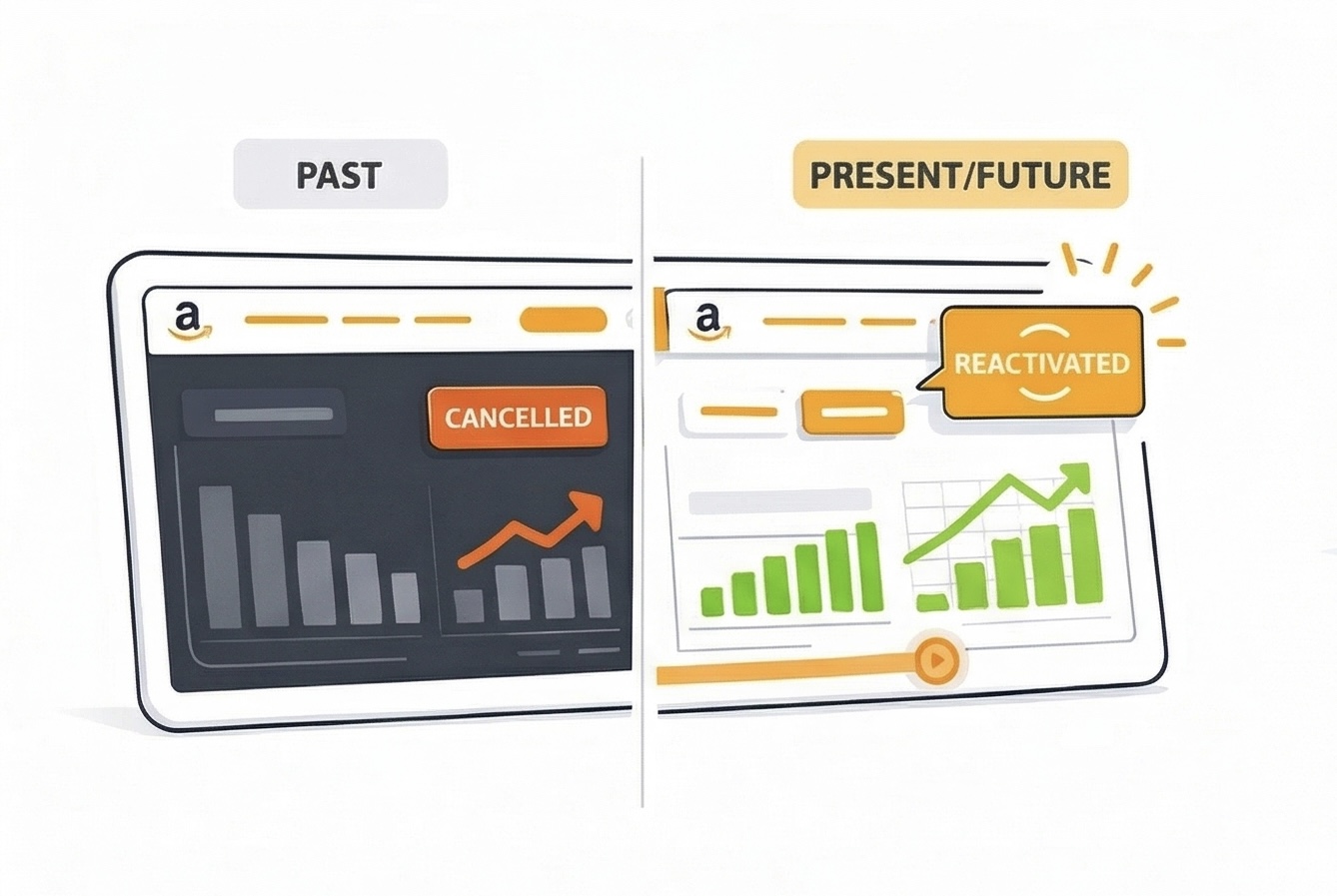
Brands spent tens of thousands on DSP, watched dashboards claim four-figure ROAS, paused everything, and saw zero change in actual sales. The attribution was overcounting. This pattern repeated across dozens of accounts between 2019 and mid-2024.
A brand would run DSP for 60 or 90 days, see impressive dashboard numbers, pause the campaigns, and their revenue stayed exactly flat.
Real Example: $25K Spent, Zero Incremental Sales
One brand spent $25,000 on DSP over 3 months. The dashboard reported $120,000 in attributed revenue. They paused in month 4. Revenue that month: $41,000 — exactly the same as their previous 3-month average. DSP was not driving $40,000 per month. It was crediting itself for $40,000 that was happening organically.
Why Did Last-Click Attribution Fail for DSP?
Last-click attribution works for bottom-funnel tactics like Sponsored Products, where a shopper searches a term, clicks an ad, and buys immediately. The causal chain is direct. DSP operates at different funnel stages: awareness, consideration, and retargeting people who are not yet ready to buy. Last-click attribution cannot capture that value accurately, and for DSP, it systematically distorted it upward.
The old model gave DSP full credit for any sale following an ad exposure, even when that exposure had no influence on the purchase. A shopper watches a streaming TV ad on Fire TV. They do not click anything. Three weeks later they search a generic category keyword, find the listing in organic results, and buy. Old DSP attribution counted the full order value as DSP-attributed revenue.
How Bad Was the Double-Counting Problem?
Industry estimates from 2024 put non-incremental DSP-attributed sales at 20 to 40 percent of total credited revenue. Turn DSP off, and those sales would still happen organically.
Retargeting amplified the problem further. Retargeting audiences of listing visitors captured buyers who were already in-market and likely to convert. DSP took credit for 100 percent of those conversions, even though the retargeting ad had changed almost nothing.
The Overcounting Pattern
Dashboard Said
- DSP spend$25,000
- Attributed revenue$120,000
- Reported ROAS4.8x
Reality (Pause Test)
- Revenue with DSP on$41,000/mo
- Revenue with DSP off$41,000/mo
- Actual incremental lift$0
What Changed in Amazon DSP Attribution for 2025 and 2026?
Amazon rebuilt the entire DSP attribution framework from the ground up in 2025, not an adjustment to the existing model but a full rebuild introducing 3 major upgrades: multi-touch attribution with AI modeling, extended lookback windows of up to 5 years, and randomized controlled trials that prove incremental lift against a matched control group.
How Does Multi-Touch Attribution Fix Phantom Conversions?
Multi-touch attribution launched at Amazon Accelerate 2025 and distributes credit across every touchpoint in the customer journey rather than awarding it all to the last interaction. If a shopper saw a DSP ad, then clicked a Sponsored Product, then returned through organic search and purchased, each touchpoint receives partial credit weighted by its actual influence on the sale.
Phantom conversions disappear under this model because DSP cannot claim 100 percent credit. A DSP impression that preceded an organic conversion by 3 weeks gets weighted differently from a DSP click that preceded a purchase by 10 minutes.
Why Do Extended Lookback Windows Matter?
Amazon Marketing Cloud now supports up to 5 years of data for long purchase cycles. For replenishment products, 25 months of ad traffic data reveals year-over-year patterns that short lookback windows missed entirely.
A first interaction with a DSP ad followed by a conversion 90 days later represents real top-of-funnel value. A 6th purchase from an existing customer who happened to see a retargeting ad is something different. The new model tracks that distinction across the full customer history.
What Are AI-Driven Incrementality Tests?
Amazon Marketing Cloud now includes custom machine learning models that run propensity scoring and churn prediction, enabling audience segmentation by likelihood to convert. Brands can build separate audiences of high-propensity and low-propensity shoppers and measure whether DSP moves the needle differently across those groups.
The 3 Attribution Upgrades
- Multi-touch attribution — distributes credit across every touchpoint weighted by actual influence
- 5-year lookback windows — distinguishes new customer acquisition from organic repeat purchases
- Randomized controlled trials — proves causal lift by comparing exposed vs. suppressed groups
How Does the New System Prove Incremental Lift?
The new framework measures what happens with DSP running against what happens without it, then credits only the difference. Two matched audiences are built in AMC with similar demographics, purchase history, and behaviour. Group A sees DSP ads. Group B does not.
After 30 to 60 days, if Group A converts at 8 percent and Group B converts at 5 percent, DSP's incremental lift is 3 percentage points. That figure is measurable, reproducible, and directly attributable to the ads.
What Is the Difference Between Old and New Attribution Logic?
Attribution Logic: Old vs. New
Old Model (2019–2024)
“An ad worked because someone saw it and later bought.”
Correlation — presence, not causation
New Model (2025+)
“An ad worked because people who saw it bought at a measurably higher rate than people who did not.”
Causation — proven incremental lift
With 5-year lookback data, the system can also prove whether DSP is acquiring new-to-brand customers or accelerating repeat purchases from existing ones. Suppress DSP for a control group for 90 days. If that group's purchase rate stays flat while the exposed group's rises, the long-term brand-building impact is quantified, not just asserted.
What Do Real Incrementality Test Results Look Like?
A pet supplement brand ran a holdout test in Q4 2025. Half their target audience saw DSP ads. Half did not. After 60 days:
Pet Supplement Brand: 60-Day Holdout Test
- New-to-brand conversion lift (exposed vs. control)+22%
- Repeat purchase rate lift+18%
- DSP spend$12,000
- Proven incremental revenue$47,000
- Verified ROAS (against control)4x
When the brand paused DSP in month 3, the previously exposed group's conversion rate declined toward the control group's baseline over 30 days. That trajectory is the evidence. The ads were driving behaviour, not just claiming credit for it.
Do Brands See Real Drops When They Pause DSP Now?
The rebuilt framework passes the pause test. Turn DSP off and incremental sales drop. Turn it back on and incremental sales rise. Before mid-2024, pausing DSP changed nothing. Revenue held steady. That was the evidence attribution was broken. The pause test now shows a different result.
How Did the Same Brand Get Different Results in 2024 vs. 2025?
Same Brand, Same Category: 2024 vs. 2025
Early 2024
- DSP spend$15,000
- Dashboard attributed$65,000
- Revenue after pause$32,000/mo
- Actual liftNone
Late 2025
- DSP spend$18,000
- Dashboard attributed$52,000
- Holdout test gap11% vs 8.5%
- Proven incremental$13,000/mo
Lower dashboard number, but more accurate. When they paused in month 4, the exposed group's rate dropped 2 points over 30 days. The suppressed group stayed flat.
How Are Brands Using Propensity Scoring to Improve DSP Efficiency?
A kitchen gadget brand that quit DSP in 2023 after seeing no lift on pause returned in Q4 2025. Using AMC's custom ML models, they scored their audience by propensity to convert and found:
Propensity Scoring: Where DSP Actually Drives Lift
Low-Propensity Shoppers
18% lift
Not already planning to buy — DSP changed behaviour
High-Propensity Shoppers
3% lift
Would likely have converted anyway — minimal impact
The old attribution model credited both groups equally. The new model let them reallocate budget away from retargeting existing buyers and toward cold traffic acquisition. DSP efficiency improved 35 percent. When they paused, they recorded a measurable drop in new-to-brand conversions for the first time.
Is Amazon DSP Worth Reconsidering in 2026?
Abandoning DSP in 2023 or 2024 because the attribution was inflating results was a rational response to a real problem. Avoiding DSP in 2026 for the same reasons means avoiding a problem that no longer exists in the rebuilt system.
What Does a Proper DSP Test Look Like Now?
A 60-day test with a control group built in from day one gives a clear answer within 2 months. If DSP is not driving incremental sales, the exposed and control groups will perform the same. Pause it, lose nothing, move on.
If it is driving incremental sales, the gap between the 2 groups will be visible by day 30. Scale what produces the lift. Suppress what does not.
Full Journey Visibility
Because the new framework connects to AMC, the full customer journey is visible: whether DSP is bringing in new-to-brand customers or accelerating repurchases, which creatives and placements are moving the needle, and which audiences are worth the spend.
What Are Brands Seeing With the New Attribution Framework?
Late 2025 Industry Results (Control-Group Verified)
- Efficiency gains30–40%
- Conversion lift (best verticals)144%
- Cost per acquisition reduction35%
- Amazon DSP revenue growth (YoY 2025)+24%
All figures measured against control groups, not self-reported by dashboards. Source: Amazon earnings data, brand case studies.
Sellers spending six figures monthly on Sponsored Products and Sponsored Brands without using DSP are leaving incremental growth on the table based on information that is now 2 years out of date. The attribution model that broke the platform's credibility was rebuilt. The holdout test infrastructure that proves real lift now exists inside AMC. The data is available to verify the claim before committing meaningful budget.
The specific attribution failures that drove your decision to quit DSP have been rebuilt. The data to verify that claim is now available before committing meaningful budget.