Key Takeaways
- 1.A window product drives ad clicks and catalog traffic but generates most of its value through cross-sell purchases that standard attribution tools including Sellerboard cannot see, because Amazon only reports the advertised ASIN in default attribution.
- 2.One seller nearly paused a campaign showing 62 percent ACoS that was generating $17,000 in annual profit through accessory cross-sells invisible to their dashboard.
- 3.The free Purchased Product Report in Seller Central reveals both the advertised ASIN and the actual purchased ASIN, exposing cross-sell revenue that transforms apparent losers into campaigns running at 7x or higher true ROAS.
- 4.Categories with the highest cross-sell attachment rates include Beauty at 40 to 60 percent, Kitchen at 35 to 50 percent, and Electronics at 25 to 40 percent.
- 5.True ROAS for a window product equals direct revenue plus cross-sell revenue divided by ad spend: a campaign that showed negative $72 monthly in Sellerboard produced positive $1,362 monthly in true profit on the same data.
- 6.A 5-stage fix covering identification, measurement, protection, scaling, and re-measurement over 3 months restructures how campaign profitability is evaluated.
General Summary
Amazon sellers using standard profit tools like Sellerboard face a critical attribution blind spot: window products that drive ad clicks but generate most of their catalog value through cross-sell purchases that default attribution cannot track. One seller nearly paused a campaign showing 62 percent ACoS that was generating $17,000 in annual profit through accessory sales invisible to their dashboard.
The free Purchased Product Report inside Seller Central reveals this hidden revenue by displaying both the advertised ASIN and the actual purchased ASIN, exposing cross-sell patterns that transform apparent losers into high-ROAS campaigns. Categories with the highest attachment rates include Beauty at 40 to 60 percent, Kitchen at 35 to 50 percent, and Electronics at 25 to 40 percent.
A 5-stage framework covering identification, measurement, protection, amplification, and re-measurement over 3 months allows brands to capture true campaign profitability and stop cutting their most effective traffic sources based on incomplete data. Amazon's default attribution was built to track one click and one sale. That model does not reflect how customers actually shop.
The Hidden Revenue Your Dashboard Cannot See
A seller paused a campaign showing 62 percent ACoS in Sellerboard and their organic sales dropped 60 percent overnight. The Purchased Product Report, free and built into Seller Central, is the tool that reveals the attribution gap standard dashboards cannot see.
A chef's knife campaign showing a $72 monthly loss in Sellerboard produced $1,362 in monthly profit when cross-sell revenue was counted. Not every product is a window product: Beauty categories show 40 to 60 percent attachment rates while books and single-use consumables show minimal cross-sell.
A 5-stage framework over 3 months transforms campaign profitability evaluation through identification, measurement, protection, amplification, and re-measurement. Amazon's default attribution was built to track one click and one sale, but customers browse, compare, and buy multiple products from a single ad interaction.
Why Sellers Systematically Kill Their Best Campaigns
Amazon advertising attribution has been misaligned with actual customer shopping behaviour since the platform's early days, creating a systemic blind spot that compounds in cost as catalogs grow more interconnected.
The gap between standard attribution models and true purchase behaviour is widest in categories where accessory and complementary product ecosystems drive significant revenue. What profit tools report as underperforming campaigns often represent the highest-leverage traffic sources in a catalog, functioning as customer acquisition engines rather than direct conversion vehicles.
This attribution failure reinforces itself over time: sellers systematically defund their most effective campaigns while over-investing in products that appear profitable only because their revenue was misattributed.
Sellers who identify window products and protect them from standard optimisation decisions gain a structural advantage that is largely invisible to competitors still relying on dashboard ACoS alone.
◆Stop optimising for the click. Optimise for the customer.
Why Did Pausing a 62 Percent ACoS Campaign Kill 60 Percent of Organic Sales?
A seller paused a campaign showing 62 percent ACoS in Sellerboard. Their organic sales dropped 60 percent overnight. That campaign was generating $17,000 in annual profit. Sellerboard could not see it. The seller almost eliminated their most profitable traffic source based on a number that was completely wrong.
This pattern appears in every catalog audit. Products that look unprofitable in Sellerboard, Perpetua, and even Amazon's Campaign Manager generate 2x, 3x, sometimes 7x more revenue than the dashboards show. The reason is window product attribution, and almost nobody checks for it.
What Is a Window Product and Why Can't Profit Tools Track It?
A window product gets the click and the attention but not always the purchase. Think of a retail store window: the featured item draws people inside, but customers leave with the displayed item, shoes, a bag, and accessories. The window did its job. Measuring only window sales would make it look like it was failing.
Sellerboard calculates profit by a simple chain: customer clicks ad, customer buys that product, Sellerboard subtracts fees and ad cost. Clean logic. Completely wrong for roughly 30 percent of most catalogs. Sellerboard cannot see what else the customer bought after clicking.
How Does Cross-Sell Attribution Break Your Dashboard Numbers?
A seller running Sponsored Products ads for a chef's knife sees this in their data: a customer clicks the knife ad, then buys the knife, a sharpening stone, and a knife sheath. Three products. One click. Sellerboard records only the knife sale.
What Your Dashboard Sees vs. What Actually Happened
Sellerboard Shows
- Knife sale$60
- ACoS62%
What Actually Sold
- Knife$60
- Sharpening stone$25
- Knife sheath$15
- True ACoS~12%
What Happens When You Pause the Window Product?
The data appears to recommend a clear action: the knife is losing money, the sharpener is pure profit, pause the knife ads and let the organic sharpener sales continue. Those sharpener sales are not organic. They are 100 percent dependent on knife ad traffic.
Real Seller Forum Example
Sellerboard showed 62 percent ACoS. The seller was ready to kill the campaign. They ran the Purchase Product Report first and found actual ROAS was 5.2x because of cross-sell. Trusting Sellerboard would have cut their most profitable campaign.
How Do You Access the Purchased Product Report in Seller Central?
Amazon provides the data to close this attribution gap at no cost. The Purchased Product Report is free, built into Seller Central, and used by almost nobody.
How to Pull the Report
- 1.Go to Seller Central → Reports → Advertising Reports
- 2.Click Create Report
- 3.Choose Purchased Product as the report type
- 4.Set date range to 30 days minimum (90 days for seasonal products)
- 5.Run the report and download the CSV
What Two Columns Reveal Your Hidden Revenue?
The report contains 2 critical columns: Advertised ASIN and Purchased ASIN. Advertised ASIN is the product the ad showed. Purchased ASIN is the product the customer actually bought. When those 2 columns contain different values, that is the window product effect in the data.
Purchased Product Report: Knife Campaign Example
- Advertised: Chef's Knife → Purchased: Chef's KnifeDirect sale ✓
- Advertised: Chef's Knife → Purchased: Sharpening StoneCross-sell (missed)
- Advertised: Chef's Knife → Purchased: Knife SheathCross-sell (missed)
Four sales, one ad click, one sale counted by standard attribution.
How Do You Identify a Window Product in Your Catalog?
Divide total cross-sell revenue by total revenue from that campaign. If the result exceeds 50 percent, the advertised product is a window. It is a traffic driver, not the profit centre.
How Did a Losing Campaign Generate $16,344 in Annual Profit?
A chef's knife campaign showed a $72 monthly loss in Sellerboard. The Purchase Product Report showed $1,362 in monthly profit. Same campaign. Same underlying data. Completely different conclusion.
What Did Standard Attribution Miss in the Knife Campaign?
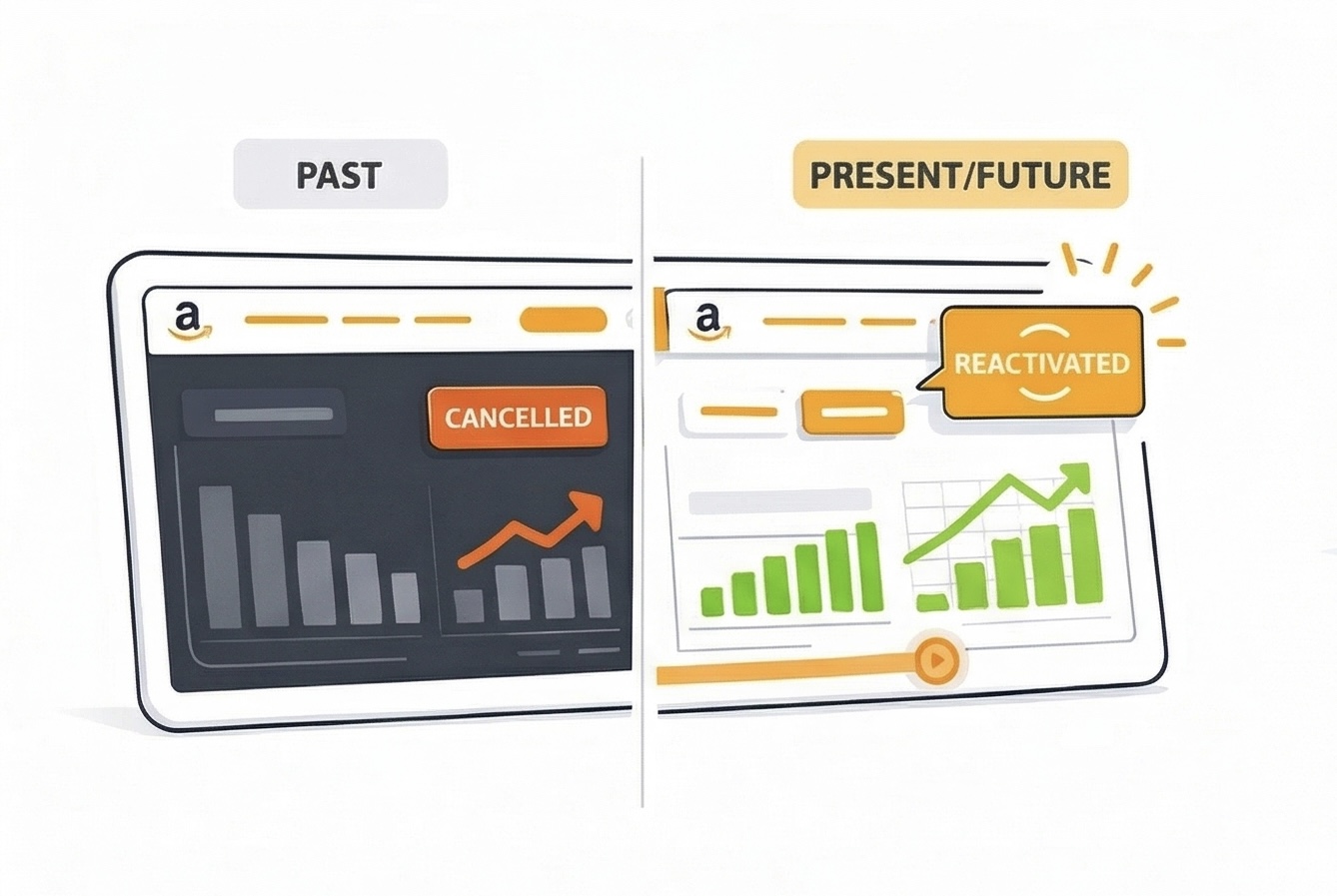
Knife Campaign: Standard vs. True Attribution
Standard Attribution (Sellerboard)
- Revenue (knife only)$2,100
- Ad spend$500
- Fees + COGS$1,672
- ROAS4.2x
- Monthly profit–$72
True Attribution (Purchase Report)
- Knife sales (35)$2,100
- Sharpening stones (45)$1,125
- Knife sheaths (28)$420
- Cutting boards (12)$285
- True ROAS7.86x
- Monthly profit+$1,362
Same campaign, same month, $1,434 difference in measured profitability.
What Is the Annual Impact of Wrong Attribution Decisions?
Trusting Sellerboard on this campaign means pausing it, saving an apparent $72 monthly loss, which is $864 annually recovered. Trusting the Purchase Product Report means keeping it running, generating $1,362 monthly, which is $16,344 annually in profit.
The swing between those 2 decisions: $17,208 per year on one campaign.
Electronics Example: Earbuds as Window
An earbuds campaign showed 50% ACoS, appearing break-even at best. The Purchase Product Report revealed earbuds were driving webcam sales: 50 earbud sales at $2,000 plus 150 webcam cross-sales at $12,000 produced $14,000 in total revenue on $1,000 in ad spend. True ROAS: 14x. True ACoS: 7.1%.
Which Product Categories Have the Highest Cross-Sell Rates?
Not every product functions as a window. Some products sell themselves as standalone destinations. Others exist primarily to bring traffic into the catalog.
Cross-Sell Attachment Rates by Category
High Cross-Sell
- Beauty (shampoo, skincare)40–60%
- Kitchen (knives, cookware)35–50%
- Electronics (earbuds, cables)25–40%
- Apparel (shoes, basics)20–35%
Low Cross-Sell (Destination Products)
- —Books
- —Single-use consumables
- —Highly specialised tools
Standard attribution is reliable for destination products. It is not reliable for categories with natural accessory ecosystems.
How Do You Know If Your Product Is a Window or a Destination?
A product with natural accessories or companion items in the same catalog is likely a window. A standalone product with no related catalog items is likely a destination. Windows require the Purchase Product Report to evaluate accurately. Destinations can trust standard attribution.
What Is the 5-Stage Fix for Window Product Attribution?
This 5-stage framework applies to every brand with a multi-SKU catalog. Run through all 5 stages over 3 months to restructure how campaign profitability is evaluated and protected.
How Do You Identify and Measure Window Products?
Stage 1, Identify (Week 1): Pull the Purchase Product Report for the last 90 days. Sort by Advertised ASIN. Flag any ASIN where cross-sell revenue exceeds 30 percent of total revenue from that campaign. Those are the windows.
Stage 2, Measure (Week 2): Calculate true ROAS for each window product using the formula: direct revenue plus cross-sell revenue divided by ad spend. Any campaign where true ROAS exceeds the target threshold stays on, regardless of what the standard dashboard shows.
How Do You Protect and Scale Window Product Campaigns?
Stage 3, Protect (Week 3): Tag window campaigns internally and document the cross-sell ratios. No decisions are made on these campaigns without first checking the Purchase Product Report. No optimisation based on standard ACoS alone.
Stage 4, Amplify (Month 2): If a window product is driving 7x true ROAS, scale it. Increase budget 20 to 30 percent and test additional keywords. The cross-sell effect typically scales proportionally with traffic volume.
Stage 5, Measure Again (Month 3): Re-pull the Purchase Product Report. Verify the cross-sell ratios have held through the scaling period. Some window products are seasonal. Others are evergreen. The data distinguishes them.
5-Stage Framework Summary
- Identify — flag ASINs with >30% cross-sell revenue
- Measure — calculate true ROAS including cross-sell
- Protect — tag and document, no decisions on standard ACoS alone
- Amplify — scale window campaigns 20-30% and test new keywords
- Re-measure — verify cross-sell ratios held through scaling
What Are the Four Automation Options for Cross-Sell Tracking?
Cross-Sell Tracking Options
Manual Allocation
2–3 hours/month • Free
Calculate attribution percentages, allocate ad spend proportionally, recalculate P&L manually.
Campaign Bundle Analysis
1 hour/month • Free
Evaluate campaign ecosystems instead of individual ASINs. Divide total revenue by total ad spend. Most brands start here.
Amazon Marketing Cloud
$900–$5,000/month
SQL queries identifying exact cross-sell patterns with multi-touch attribution. Highest accuracy, highest cost.
Custom BI Dashboards
$1,500–$3,000/month
Tableau or Looker automate Purchase Product Report imports into custom profitability views.
Why Does Amazon Attribution Fail to Show Your True Profitability?
Amazon's default attribution was built to track one click and one sale. That model does not reflect how customers shop. They browse, compare, add multiple items to cart, and buy 3 things because an ad showed them one.
Sellerboard and similar tools can only see what Amazon's standard attribution reports. Standard attribution does not report cross-sell. The campaigns that appear to be failing may be funding the entire catalog. The Purchase Product Report is the tool that makes that visible.
Stop optimising for the click. Optimise for the customer.